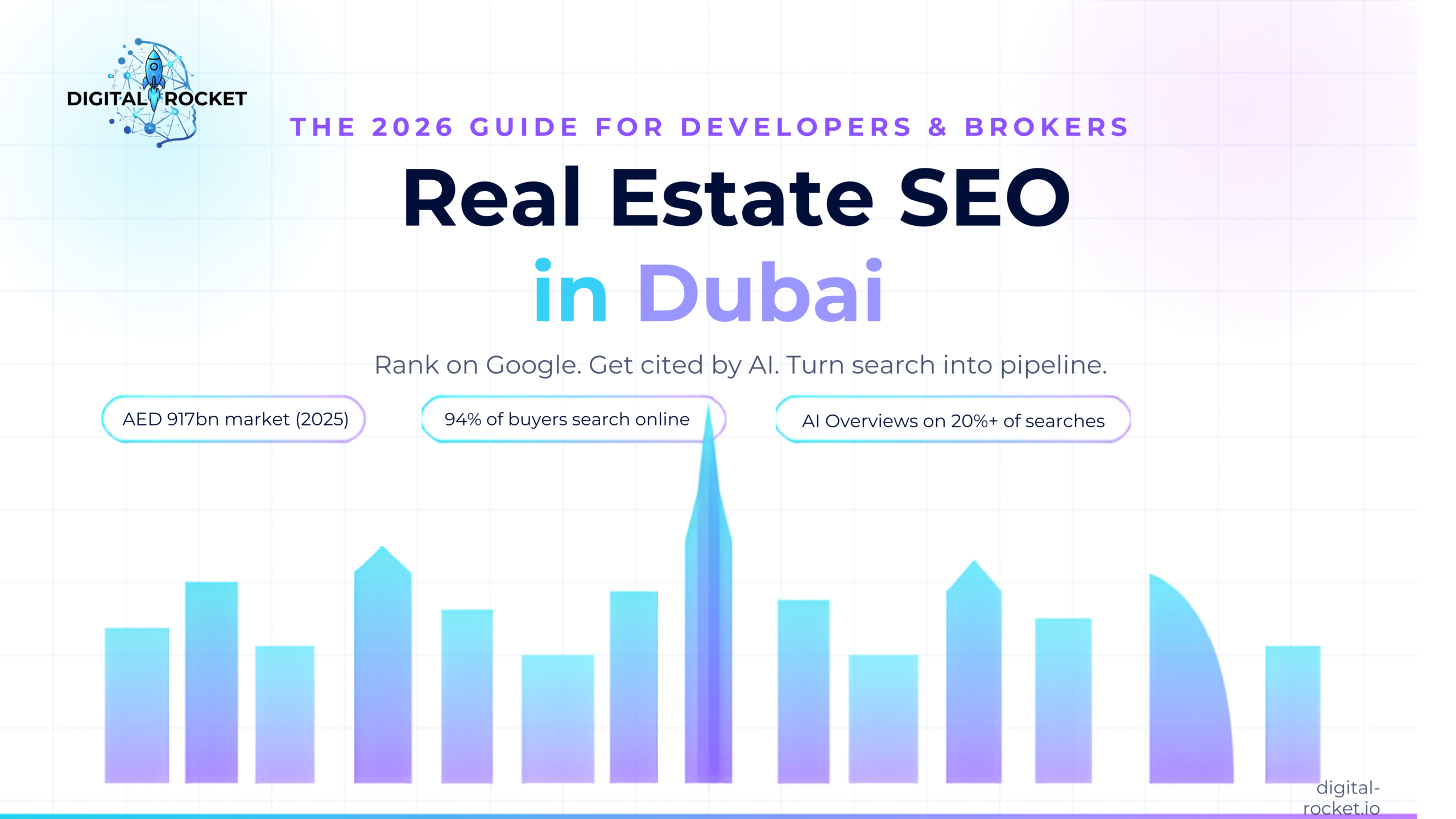
Dubai’s property market just posted its biggest year on record – over AED 917 billion in real estate transactions in 2025, up 20% year on year (Dubai Media Office, 2026). Yet most developers and brokerages still rent their visibility: portal subscriptions, shared leads, and paid campaigns that reset to zero every month. Meanwhile, the way buyers search has fundamentally changed – Google’s AI Overviews now appear on more than 20% of searches, and roughly two-thirds of searches end without a click (Google I/O 2026, industry click studies, 2026). This guide breaks down exactly how Dubai developers and brokers should do real estate SEO in 2026 – for Google and for the AI engines answering buyers’ questions.
Why does real estate SEO in Dubai matter more than ever in 2026?
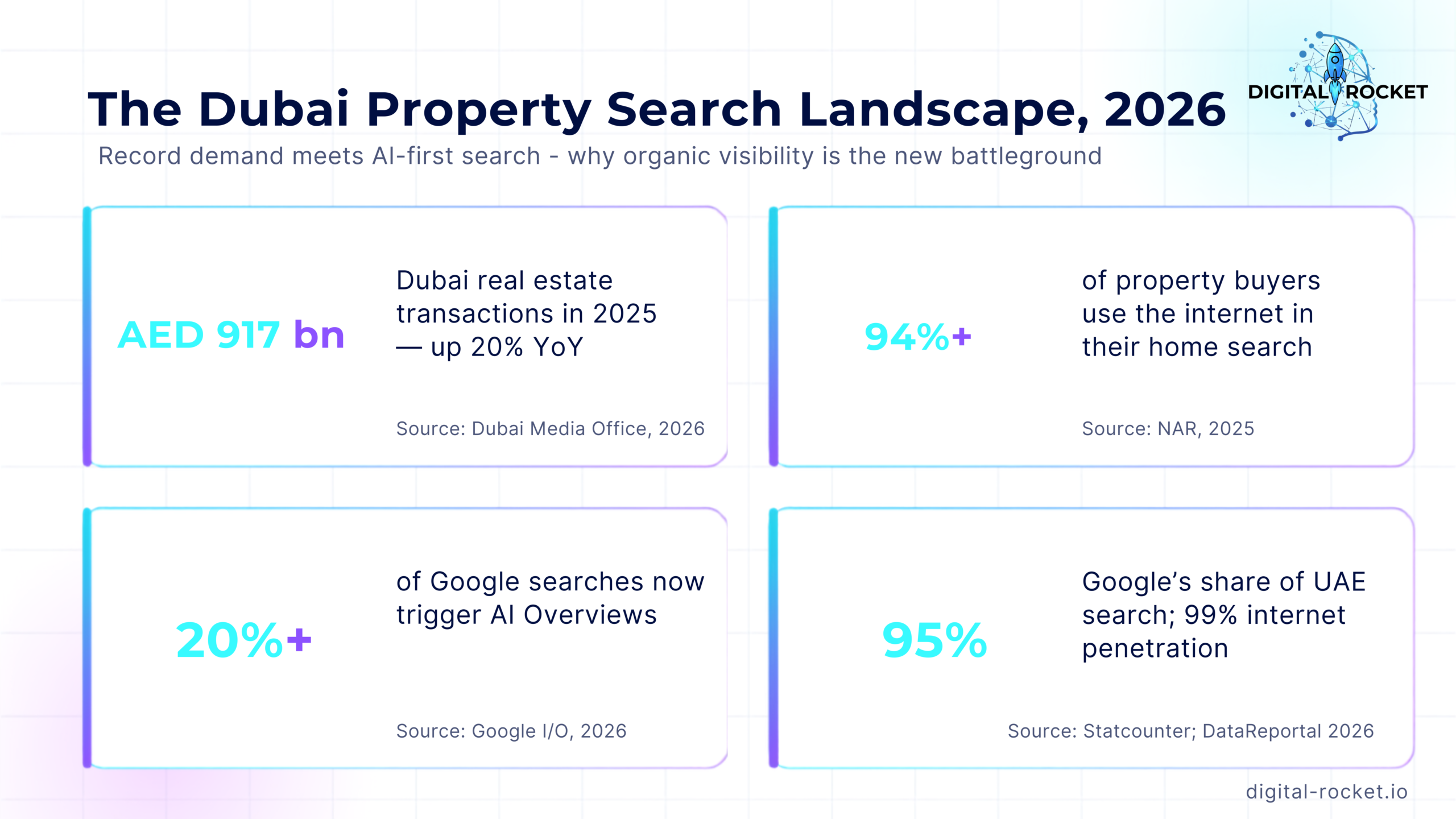
Direct answer: Because demand has never been higher and organic visibility has never been more contested. Dubai recorded 270,000+ property transactions worth AED 917 billion in 2025, and 94%+ of buyers search online, but AI answers and portals now absorb most clicks, so brands without deliberate SEO and GEO strategies are invisible at the exact moment of intent.
The numbers behind that answer are striking. Dubai’s real estate sector closed 2025 with sales of 214,912 transactions worth AED 682.5 billion — value growth of 30.7% year on year (DXBinteract/Zawya, 2026). The investor base grew 24% to roughly 193,100 investors, including about 129,600 first-time investors (Dubai Media Office, 2026). And the government’s Real Estate Strategy 2033 explicitly targets AED 1 trillion in annual transactions — meaning the demand runway extends for years.
On the buyer side, the National Association of Realtors’ research consistently finds that over 94% of home buyers use the internet in their property search (NAR Profile of Home Buyers and Sellers, 2025), and around three-quarters begin that search on a mobile device. In the UAE specifically, internet penetration sits at 99% (DataReportal, Digital 2026: UAE) and Google holds roughly 95% of search engine market share (Statcounter, 2026). Search is not one channel among many for Dubai property — it is the primary battlefield for buyer attention.
What is real estate SEO and how is it different in Dubai?
Direct answer: Real estate SEO is the discipline of ranking your property websites, project pages, and content for buyer and investor searches — organically. In Dubai it differs from Western markets in three ways: portal dominance (Bayut, Property Finder), a multilingual international buyer base, and an off-plan-driven market where search demand spikes around project launches.
In the US or UK, a brokerage competes mostly with other brokerages. In Dubai, the organic SERP for almost any transactional property query is dominated by two aggregators — and both are racing into AI. Bayut launched BayutGPT, the region’s first conversational AI property assistant, and Property Finder has rolled out AI-driven valuation tools with six-month price predictions. The portals have accepted that property discovery is shifting from filters to conversations.
The second difference is audience: Dubai’s buyers search in English, Arabic, Russian, Hindi, and Mandarin, from 100+ countries, often researching remotely before ever visiting. The third is market structure: off-plan sales dominate transaction volume, which means search demand is constantly being created around new project names, payment plans, and communities — brand-new SERPs where even a young domain can win.
How do you compete with Bayut and Property Finder?
Direct answer: You don’t outrank portals on head terms — you out-publish them on depth. Portals win “apartments for sale in Dubai”; you win “Is [community] a good investment in 2026”, “off-plan payment plans compared”, and “service charges in [tower]”. Long-tail, expertise-led content is also precisely what AI engines cite.
Here is the strategic insight most Dubai brokerages miss: portals are listing databases, not advisors. Their pages answer “what is available?” but not “what should I buy, where, and why?” That advisory gap is your organic territory. Comparison pages, community deep-dives, ROI analyses, developer track-record reviews, and step-by-step buying guides for foreign investors routinely outperform portal pages on specific queries — and research on generative engines shows comparison and case-style content earns roughly a third of all AI citations.
The Princeton GEO study found that adding citations, quotations, and statistics can improve content visibility in generative engine responses by up to 40% (Aggarwal et al., GEO: Generative Engine Optimization, 2023). For real estate, that means data-rich pages — transaction stats, rental yields, service-charge benchmarks — are not just more useful to buyers; they are mathematically more likely to be quoted by ChatGPT and Gemini when someone asks “best areas to invest in Dubai”.
Which keywords should Dubai developers and brokers target?
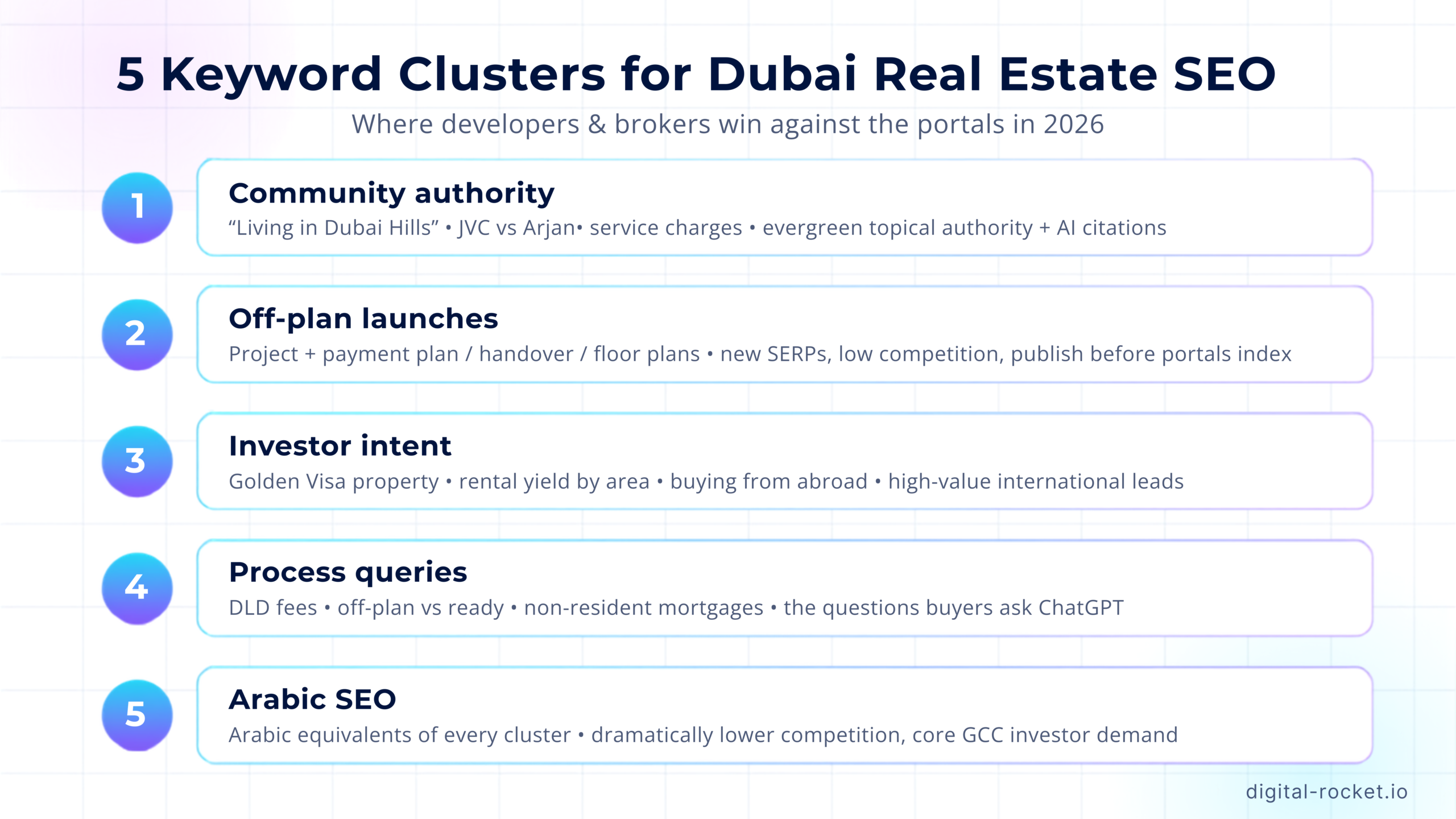
Direct answer: Build five clusters: (1) community and area guides, (2) off-plan project and developer terms, (3) investor-intent queries like Golden Visa and rental yield, (4) process queries — fees, DLD charges, mortgages for non-residents, and (5) Arabic-language equivalents. Prioritize queries where portals rank with thin content and where your GSC already shows impressions.
- Community authority cluster: “living in Dubai Hills Estate”, “JVC vs Arjan for investment”, “Dubai Marina service charges 2026” — evergreen pages that build topical authority and earn AI citations.
- Off-plan launch cluster: project name + “payment plan”, “handover date”, “floor plans”, “price” — new SERPs with low competition, high commercial intent, and short windows. Speed matters; publish before the portals index.
- Investor cluster: “Dubai Golden Visa property investment”, “Dubai rental yield by area 2026”, “buying property in Dubai from [country]” — high-value international traffic with long decision cycles, ideal for lead magnets.
- Process cluster: “DLD transfer fee calculator”, “off-plan vs ready property”, “mortgage for non-residents UAE” — answer-engine gold: these are exactly the questions buyers ask ChatGPT.
- Arabic cluster: Arabic equivalents of the above. Competition is dramatically lower, and GCC investors remain a core off-plan buyer segment.
How do you optimize for AI search (GEO/AEO) in real estate?
Direct answer: Structure every page so an AI can lift the answer: a 40–60 word direct answer under each heading, hard statistics with named sources, FAQ schema, and entity-rich writing. With Google’s AI Mode passing one billion monthly users (Google I/O 2026), being citable now matters as much as ranking.
- Answer-first formatting. Every H2 poses the question buyers actually ask; the first paragraph answers it completely in 40–60 words. AI Overviews and ChatGPT reward extractable answers.
- Statistics with attribution. “Dubai recorded AED 917 billion in transactions in 2025 (Dubai Media Office)” is citable; “the market is booming” is not.
- Structured data. BlogPosting, FAQPage, BreadcrumbList on editorial content; RealEstateListing and Product schema on inventory pages; Organization and LocalBusiness sitewide.
- AI crawler access. Verify GPTBot, PerplexityBot, ClaudeBot and Google-Extended are not blocked in robots.txt — we published a full audit checklist for this.
- Original data. Quarterly transaction roundups, yield tables, and price-per-square-foot trackers make your domain the source AI engines link to. One warning: Google’s June 2026 spam update explicitly targeted scaled AI content lacking editorial oversight (Search Engine Journal, 2026) — volume without expertise is now a liability.
This is the core of how we approach AI-based optimization at Digital Rocket: engineering content that both ranks in classic SERPs and gets cited in AI answers.
What technical and local SEO do Dubai property sites need?
Direct answer: Fast, indexable, structured, and localized. That means Core Web Vitals passing on mobile (where 76% of buyers start), clean indexation of listing pages, hreflang for English/Arabic, RealEstateListing schema, and a fully optimized Google Business Profile for “near me” and map-pack visibility.
- Listing page indexation. Index community and building hub pages, canonicalize filter permutations, and keep sold/expired listings 301-ing to their parent community page.
- Mobile speed. Property sites are image-heavy; serve WebP/AVIF, lazy-load galleries, and keep LCP under 2.5 seconds. With three-quarters of buyers starting on mobile, a slow gallery is a lost lead.
- Hreflang + Arabic UX. True RTL layouts and translated metadata — not machine-translated body text bolted onto an English template.
- Local signals. A complete Google Business Profile per office, consistent NAP citations, and review velocity. For brokers, the map pack still converts phone-ready leads that AI answers can’t intercept.
How should you measure real estate SEO ROI?
Direct answer: Track qualified leads and cost per lead against your portal and paid-media benchmarks — not rankings alone. Add AI-era metrics: AI citation share (how often your brand appears in ChatGPT/Gemini answers), branded search growth, and GSC impression clusters. Expect compounding returns from months 4–9 onward.
A useful measurement stack for 2026: Google Search Console for impression-cluster growth (leading indicator), GA4 with call and WhatsApp tracking for lead attribution, and an AI share-of-voice tracker for citation monitoring. Benchmark organic cost per lead against what you pay portals for shared leads — this is where SEO’s compounding economics become obvious to CFOs. Our Prism platform pulls these performance signals into one place, so marketing leaders can see search, paid, and AI visibility in a single view.
One realistic caveat: SEO is not a launch-week channel. For a Q4 project launch, the SEO work starts now — pages published in July rank by October. Developers that treat organic as launch infrastructure, not an afterthought, consistently pay less per lead across the sales cycle. That’s the philosophy behind our growth marketing engagements: search as a compounding asset alongside performance media, not a silo.
Frequently Asked Questions
How much does real estate SEO cost in Dubai?
Most Dubai agencies price real estate SEO between AED 5,000 and AED 25,000+ per month depending on scope: number of communities targeted, languages (English + Arabic), content volume, and whether AI search optimization is included. Compare that against portal lead costs and paid CPLs, which recur monthly with no compounding asset.
How long does SEO take to generate property leads?
Expect first meaningful impressions in 6–8 weeks, long-tail rankings in 3–4 months, and consistent lead flow from months 4–9. Off-plan launch pages can rank faster because search volume is new and competition thin. AI citations can arrive even earlier than page-one rankings.
Can a broker website really compete with Bayut or Property Finder?
Not on head terms — and you shouldn’t try. Brokers win on long-tail, intent-rich queries (community guides, off-plan reviews, investor and Golden Visa content, service charges, ROI comparisons) where portals publish thin or no content, and on AI search where cited expertise beats listing volume.
Does Arabic SEO matter for Dubai real estate?
Yes. Arabic property queries face far less competition than English equivalents, and GCC investors are a core off-plan buyer segment. A proper Arabic content layer with hreflang unlocks demand most competitors ignore.
What is GEO/AEO and why does it matter for real estate?
Generative Engine Optimization (GEO) and Answer Engine Optimization (AEO) make your content citable by ChatGPT, Gemini, Perplexity and Google AI Overviews. With AI Overviews on 20%+ of searches and most searches ending without a click, being the cited source is the new page one.
Should developers rely on portals instead of their own SEO?
Portals are a channel, not a strategy. Portal leads are shared and repriced upward every year; your ranking pages are an owned asset that compounds. The strongest 2026 mix: portals for listings, owned SEO/GEO for brand, community authority, and investor content.
Turn Dubai’s record property market into your pipeline
AED 917 billion changed hands in Dubai real estate last year — and nearly every dirham of it started with a search. The developers and brokers who own their visibility in 2026 will be the ones answering buyers’ questions on Google and inside AI engines, in English and Arabic, before their competitors’ pages even load.
Digital Rocket builds exactly that: AI-native SEO and GEO programs for UAE real estate brands, backed by performance media and measurable lead economics. Book a free 30-minute strategy call and we’ll show you the specific queries and AI answers your brand is missing today.
