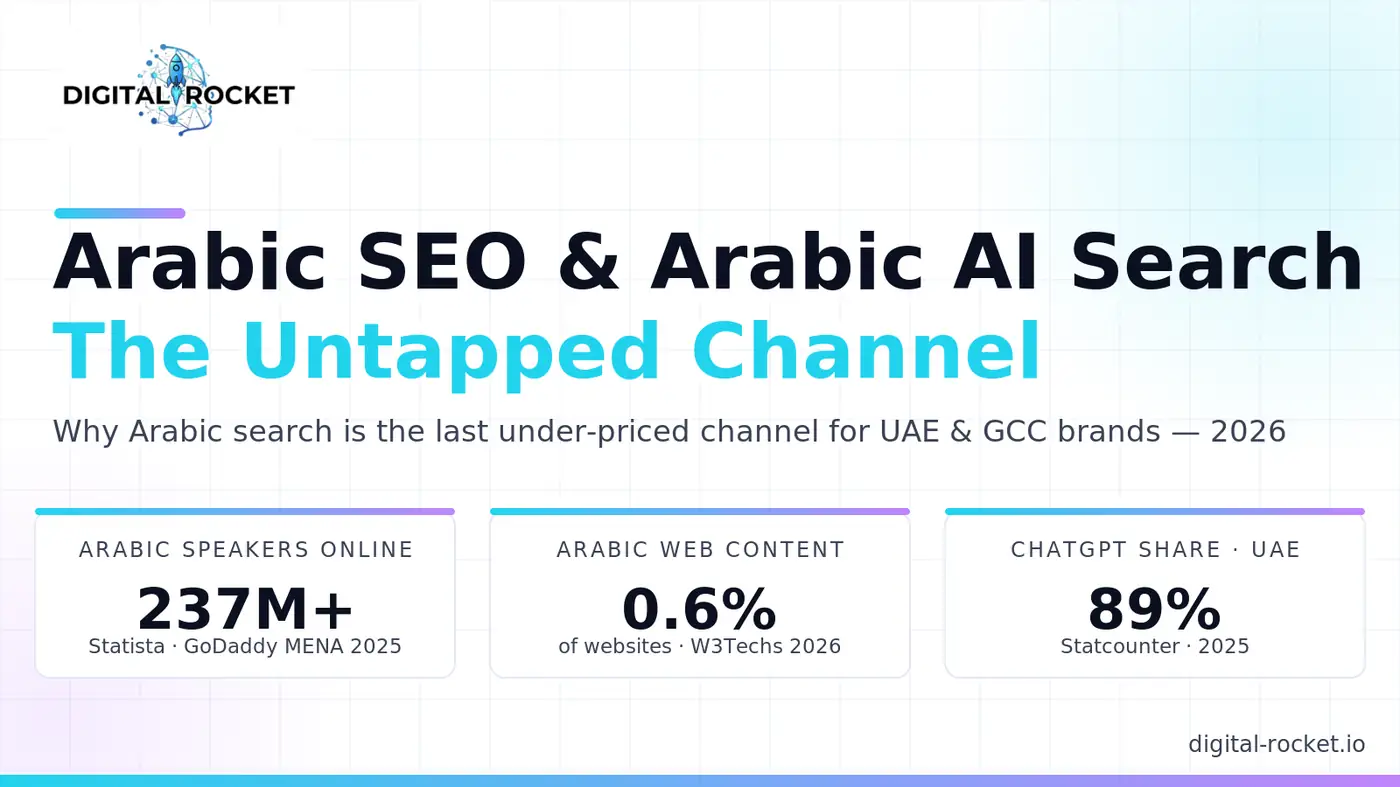
More than 237 million people use the internet in Arabic. Yet only about 0.6% of websites publish content in Arabic (W3Techs, 2026). That is one of the biggest gaps between demand and supply anywhere in search. If you run a brand in the UAE or the GCC, this gap works in your favor: less competition, faster rankings, and a real shot at becoming the brand AI assistants mention when people ask questions in Arabic. Here is how to make it happen.
Why Arabic is the biggest content gap on the internet
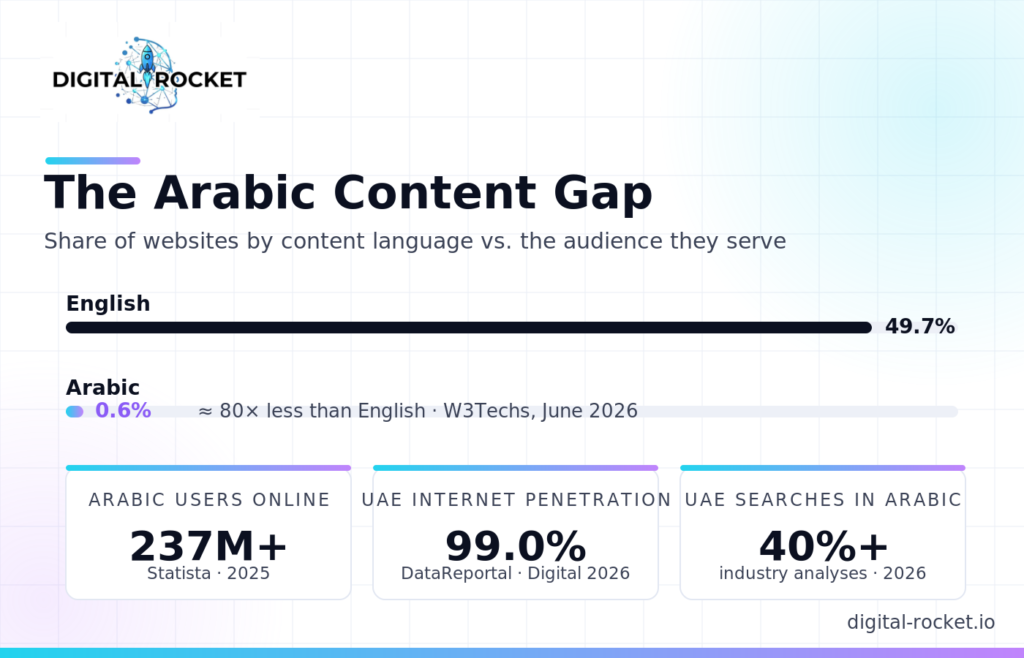
Arabic speakers are one of the largest audiences online, but the content supply never caught up. Around 237 million internet users speak Arabic, while Arabic accounts for just 0.6% of website content. English sits at 49.7% (W3Techs, June 2026). That leaves a huge amount of search demand across the GCC with very little quality content to serve it.
The numbers tell the story:
- 237M+ Arabic speaking internet users, one of the largest language groups online (Statista and GoDaddy MENA, 2025).
- Only 0.6% of websites use Arabic as their content language. English is at 49.7% (W3Techs, June 2026).
- Around 5% Arabic content by broader estimates that include social platforms, and much of that is low quality machine translation (GoDaddy MENA, 2025).
- 99.0% internet penetration in the UAE, with 11.3 million users at the start of 2026 (DataReportal, Digital 2026: UAE).
Think about the channels you compete in today. English SEO is crowded. Paid social keeps getting more expensive. Google Ads is an auction against everyone. Arabic organic search is the one channel in the region where demand is still bigger than supply.
The Arabic search opportunity in the UAE and GCC
Industry studies estimate that over 40% of Google searches in the UAE happen in Arabic, yet most UAE brands publish only in English. Because so few Arabic pages are properly optimized, Arabic keywords carry far less competition than their English versions. Brands that invest now can rank in months instead of years.
1. Your audience is bilingual. Your website probably is not. Emiratis, Saudi visitors and Arab expats switch between Arabic and English depending on what they need. Arabic tends to win for local, personal and trust heavy searches: healthcare, government services, real estate, finance. If your site only speaks English, you are invisible for that half of the journey.
2. Competition is much lower in Arabic. Try ranking for “real estate agency Dubai” in English and you are up against global portals with massive budgets. The Arabic version of that same search often has a fraction of the optimized pages competing for it. SEO teams across the region consistently report faster time to rank in Arabic (Istizada; LionUp Digital, 2025 and 2026).
3. Saudi Arabia is next door. Saudi Arabia generates roughly 458 million Google searches every month (Clicks.so, 2026), and most of them are in Arabic. If KSA expansion is on your roadmap, and for most UAE brands it is, the Arabic content you build today will work in both markets.
We see this in our own data at Digital Rocket. Google Search Console shows steady impressions for searches like “arabic seo agency uae” and “arabic seo consultant in dubai” with almost no strong pages competing for them. The same pattern shows up across our client niches.
Arabic AI search has arrived: ChatGPT, Falcon and the new answer layer
AI assistants are already a main discovery channel in the Gulf, and they are getting much better at Arabic. ChatGPT holds around 89% of AI chatbot market share in the UAE and 91% in Saudi Arabia (Statcounter, July 2025). At the same time, Gulf governments are investing heavily in Arabic AI models: Falcon in the UAE, ALLaM in Saudi Arabia, Fanar in Qatar. Brands that optimize for Arabic answers now will own those citations later.
Three signals worth knowing:
- ChatGPT reached about 900 million weekly active users by February 2026, more than double the year before (Omnibound, 2026). Middle East usage runs above the global average (AGBI, 2025).
- Abu Dhabi’s TII launched Falcon-H1 Arabic in January 2026. It is the top performer on the Open Arabic LLM Leaderboard. The 34B model scores 75.36%, beating much larger systems like Llama 3.3 70B (TII, 2026).
- Arabic benchmarks went native. The leaderboard dropped test questions translated from English and switched to questions written in Arabic. Arabic AI quality is now measured on real Arabic, and models are being tuned for it (Annota8, 2026).
Here is the part most brands miss. AI answers can only come from content that exists. When an assistant answers a question in Arabic, it pulls from a small pool of quality Arabic sources. Small pool, better odds: a well structured Arabic page has a much higher chance of getting cited than the same page would have in the crowded English pool. That makes Arabic content some of the cheapest AI visibility your brand can buy. It is a core idea behind our AI based optimization work.
Why most Arabic SEO fails
Most Arabic SEO fails for one simple reason: brands translate instead of writing for the audience. They machine translate English pages, keep left to right layouts, ignore dialect differences and skip Arabic keyword research. The result reads like a foreign website, and it rarely ranks. Poor automatic translation is a big reason so much existing Arabic content is low quality (GoDaddy MENA, 2025).
Translated keywords instead of researched ones. People do not search in Arabic the way they search in English. Phrasing is different, some users mix Arabic and English, and search volumes do not map one to one. Keyword research has to start in Arabic.
Ignoring dialect and register. Modern Standard Arabic is the safe choice for written content, but how people phrase searches, and what earns their trust, differs between Gulf, Egyptian and Levantine audiences. Arabic is also highly inflectional, so meaning can shift with small changes in form (GTECH, 2025).
A broken right to left experience. RTL affects navigation, breadcrumbs, forms and how fast Arabic fonts load. Mirroring your English template is not the same as designing for Arabic readers.
Missing hreflang. If your Arabic and English pages are not paired with correct hreflang tags such as ar-AE, they can compete with each other or get treated as duplicates.
No Arabic brand footprint. If your brand name, services and reviews only exist in English, Arabic AI retrieval and Google’s Arabic knowledge graph have nothing to connect your brand to.
The Arabic SEO and GEO playbook for 2026
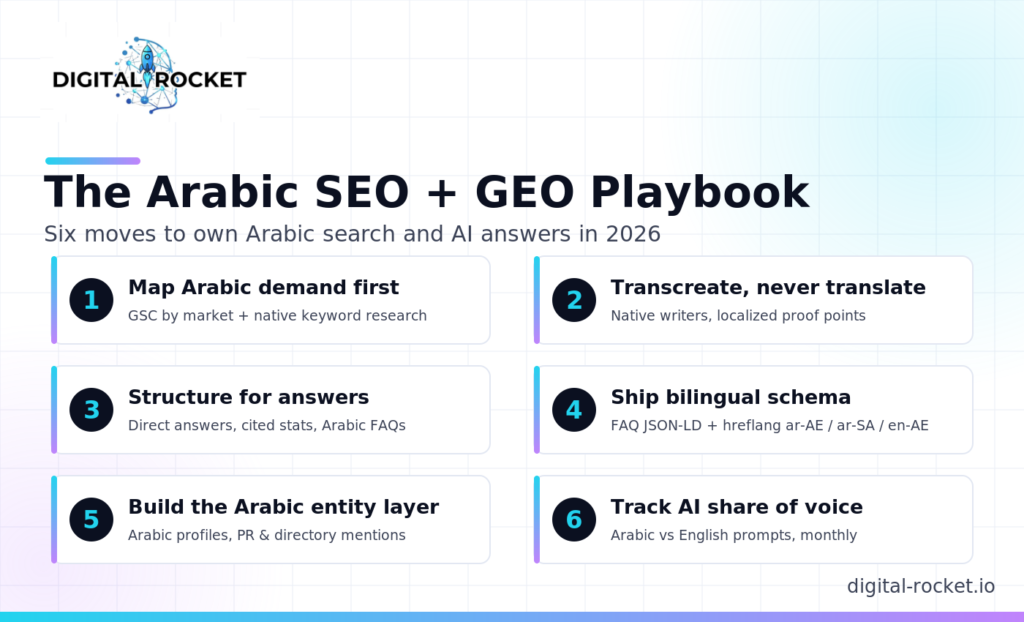
The approach that works treats Arabic as a first class channel, not a translation project. Start with native keyword research, write content that answers questions directly, publish schema in both languages, and track AI visibility from day one. In short, apply the same GEO discipline you use in English, in real Arabic.
- Map the Arabic demand first. Pull your Search Console queries by country and language. Validate with Arabic keyword tools. Focus on clusters where Arabic demand exists but the results page is weak.
- Transcreate, never translate. Brief native Arabic writers with your English page as context, not as copy to convert. Localize the examples, the currency and the proof points for UAE and KSA readers.
- Structure for answers. Put a short, direct answer at the top of every Arabic section. Back claims with sourced statistics. Add an Arabic FAQ. These are the same tactics that earn AI citations in English, and they work even better in the thinner Arabic pool.
- Ship bilingual schema. BlogPosting and FAQPage JSON-LD in both languages, the correct inLanguage value, and hreflang pairs (ar-AE, ar-SA, en-AE) so search engines serve the right version.
- Build the Arabic entity layer. Arabic business profiles, Arabic PR, directory listings and one consistent Arabic brand name. These are the citations Arabic AI retrieval depends on.
- Track AI share of voice in both languages. Once a month, test how assistants answer your category’s questions in Arabic and English. Every gap where you are not mentioned is a content brief. Our PRISM platform automates exactly this.
How to measure it (and what winning looks like)
Measure Arabic search as its own channel. Segment Search Console by Arabic queries and by market, track Arabic rankings separately from English, and add AI share of voice, meaning the percentage of AI answers in your category that mention your brand. Expect early signals such as impressions and first citations within 8 to 12 weeks, and meaningful traffic within two quarters. That is faster than typical English timelines because the competition is thinner.
A simple scorecard we use with growth marketing clients:
- Demand capture: Arabic impressions and clicks in Search Console for the UAE and KSA, quarter over quarter.
- Ranking velocity: Arabic keywords in the top 10 versus English keywords in the top 10. Arabic should move faster.
- AI visibility: how often ChatGPT, Gemini and AI Overviews mention your brand in Arabic and English answers.
- Pipeline: leads and assisted conversions from Arabic landing pages. This is the number your board cares about.
FAQ
What is Arabic SEO?
Arabic SEO is optimizing your website for Arabic search: native Arabic keyword research, right to left page design, dialect aware content, Arabic metadata and schema, and hreflang setup. Done well, it helps you rank in Google and get cited by AI assistants when people search in Arabic.
Is Arabic SEO less competitive than English SEO in the UAE?
Yes. Arabic keywords face far less competition because optimized Arabic content is still scarce. Arabic makes up about 0.6% of web content (W3Techs, 2026) while more than 237 million internet users speak Arabic. Rankings that take years in English often take months in Arabic.
Do AI assistants like ChatGPT answer Arabic queries well?
They are improving fast. ChatGPT holds about 89% chatbot market share in the UAE (Statcounter, 2025), and Gulf models like Falcon-H1 Arabic, ALLaM and Fanar now lead the native Arabic benchmarks. Because quality Arabic sources are scarce, a well structured Arabic page has a strong chance of being cited.
Should we translate our English content into Arabic?
No. Transcreate instead. Start with native Arabic keyword research, write for the dialect and intent of your audience, design for right to left reading, and localize your proof points. Machine translated pages are a big reason so much Arabic content underperforms.
What is Arabic GEO (Generative Engine Optimization)?
Arabic GEO means optimizing content so Arabic capable AI engines cite your brand in their answers. That takes direct answers at the top of each section, statistics with named sources, bilingual FAQ schema, a consistent Arabic brand footprint, and mentions on the Arabic sources AI models pull from.
How long does Arabic SEO take to show results?
Early signals like Arabic impressions and first AI citations usually appear within 8 to 12 weeks. Meaningful traffic tends to follow within two quarters. Thinner competition makes Arabic timelines faster than English ones, but only if the content is genuinely native.
Ready to own the channel your competitors ignore?
The Arabic content gap will not stay open forever. Government AI investment, Google’s Arabic AI features and growing GCC content budgets are all closing it. The brands that build authoritative Arabic content in 2026 will be the default citations for years. If you want an Arabic SEO and GEO roadmap for your brand, with a demand map, a content plan and an AI share of voice baseline, book a free 30 minute strategy call with Digital Rocket.