The search channel your budget was built for no longer exists. In the first four months of 2026, 68% of US Google searches ended without a single click, up from roughly 60% in 2024 (Omnibound, 2026). Google’s own AI Overviews now sit on top of a growing share of queries, ChatGPT passed 900 million weekly active users in February 2026 (TechnologyChecker, 2026), and UAE digital ad spend is climbing 15.2% this year to US$2.64 billion (ResearchAndMarkets, 2026). More money is chasing a channel whose economics have fundamentally changed. This guide to AI SEO in Dubai shows UAE marketing leaders exactly how to restructure search budgets for 2026 — what to cut, what to keep, and where the new line items belong.
What Is AI SEO – and Why Does It Matter for Dubai Brands Now?
AI SEO is the discipline of winning visibility in both ranked search results and AI-generated answers. It merges classic SEO (technical health, authority, rankings) with generative engine optimization GEO so your brand is cited when ChatGPT, Gemini, Perplexity or Google’s AI Overviews answer a buyer’s question. In Dubai’s answer-first market, it is now the core search strategy, not an add-on.
The distinction matters because the two systems reward different things. Rankings reward links and relevance; AI answers reward entities, structured data, statistics, quotable claims and content that directly resolves a question. Princeton’s original GEO research found that adding citations, quotations and statistics to content increased visibility in generative engines by up to 40% – tactics that traditional SEO checklists barely mention.
For the UAE specifically, the stakes are amplified by market structure: 99% internet penetration, an English/Arabic bilingual search landscape, and some of the region’s most aggressive AI adoption targets under the UAE National AI Strategy. MENA is already the fastest-growing digital ad region in the world at +17.8% in 2025 (Statista, 2025), but growth in spend does not equal growth in clicks.
How Has AI Search Changed the Economics of the Click?
Organic clicks are being repriced downward while their quality is being repriced upward. When an AI Overview appears, organic CTR for top-ranking pages drops between 47% and 61% depending on the study. Meanwhile AI referral traffic- still only 1% of sessions, converts at multiples of organic search. Fewer clicks, worth far more each: that is the new arithmetic your budget must reflect.
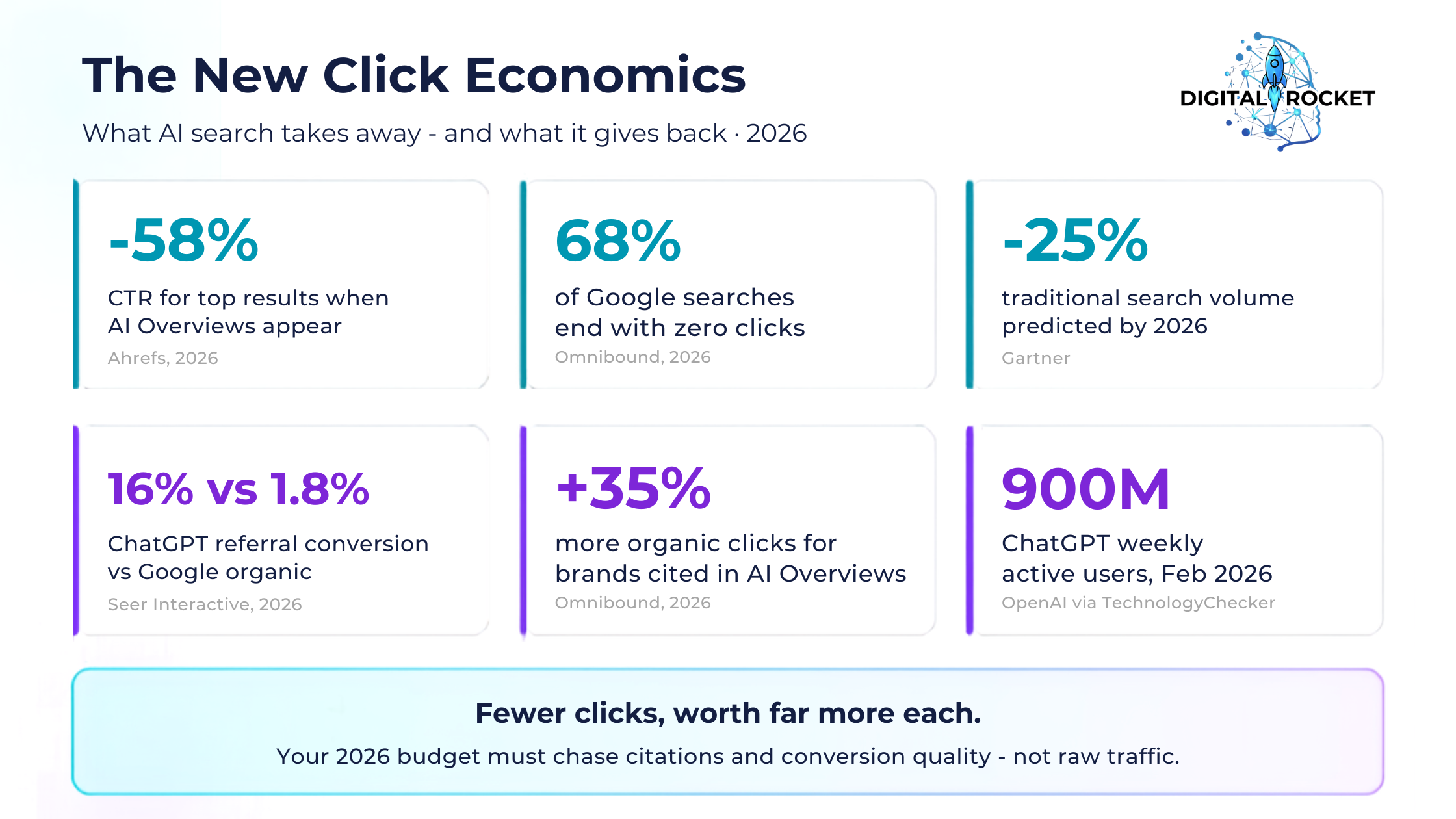
The evidence is consistent across independent datasets:
- Ahrefs measured a 58% CTR reduction for top-ranking pages on queries with AI Overviews (Ahrefs, 2026).
- Seer Interactive, analysing 2.43 billion impressions across 53 brands, found organic CTR fell 61% where AI Overviews appear (via Omnibound, 2026).
- Pew Research Center‘s controlled study of 68,000 queries confirmed a 46.7% relative decline in clicks when an AI Overview is present (Medianama, 2026).
- Gartner predicted traditional search volume would fall 25% by 2026 as users shift to AI answer engines.
Now the other side of the ledger. Brands cited inside AI Overviews earn 35% more organic clicks and 91% more paid clicks than non-cited brands on the same results page (Omnibound, 2026). Seer Interactive’s case-study data shows ChatGPT-referred traffic converting at 16% versus 1.8% for Google organic – nearly nine times higher (Demand Local, 2026). Ahrefs’ own funnel data found AI search visitors were just 0.5% of traffic but generated 12.1% of signups which is a 23x conversion edge.
How Should UAE Brands Split Search Budgets in 2026?
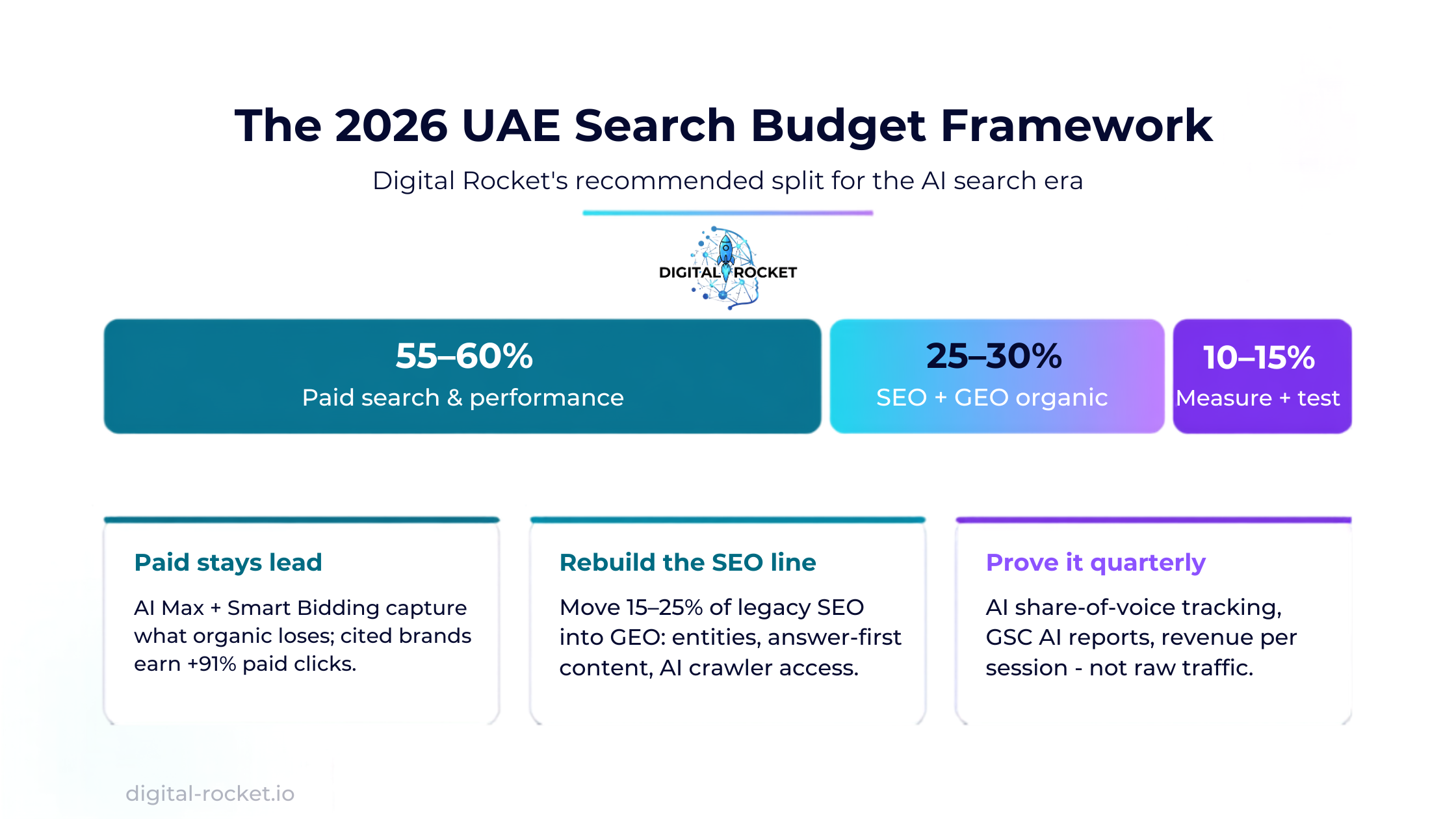
Our recommended 2026 structure for a UAE brand: keep roughly 55–60% of the search budget in performance/paid, allocate 25–30% to an integrated SEO+GEO organic program, and dedicate 10–15% to measurement and experimentation:
AI share-of-voice tracking, testing emerging surfaces, and creative for AI-facing formats. The key move is converting 15–25% of the old “SEO” line into explicit GEO deliverables.
That reallocation mirrors where the market is going. Industry analysts expect GEO to absorb 40% or more of enterprise SEO budgets by 2027, and 54% of US marketers plan to implement GEO within three to six months (Superlines, 2026). Dubai startups currently push 40–50% of monthly digital budgets into paid ads (Andava, 2026) — defensible, but only if the organic slice is rebuilt for the answer economy rather than left running a 2022 playbook.
Practical translation by company size:
- Startups / SMEs (AED 15k–50k/month total search): one integrated retainer covering technical SEO + GEO content, weighted to 3–5 high-intent topic clusters. Don’t split vendors; the disciplines share 70% of their work.
- Mid-market (AED 50k–200k/month): separate GEO line item with its own KPIs (citations, AI share of voice), plus bilingual Arabic/English entity work — an edge most UAE competitors ignore.
- Enterprise: shift 20–25% of the SEO budget to GEO, stand up quarterly AI-visibility reporting to the board, and brief paid teams on AI Max / Smart Bidding interplay so paid captures what organic loses.
What Does an AI SEO Program Actually Include?
A credible AI SEO program in 2026 has six workstreams: answer-first content engineered for citation; entity and structured-data architecture (schema, sameAs, knowledge-graph consistency), technical access for AI crawlers (GPTBot, PerplexityBot, ClaudeBot); digital PR that earns mentions on sources LLMs trust; bilingual optimization for the UAE market; and AI share-of-voice measurement. Anything sold as “AI SEO” without measurement is a rebranded 2020 retainer.
Two of these deserve emphasis. First, citation-worthy content: AI engines disproportionately cite pages with statistics, named sources, direct answers under headings, and FAQ structures. Comparison and case-study content earns roughly a third of AI citations, which is why we lean on it in our own growth marketing engagements. Second, measurement: Google Search Console expanded AI performance reporting to all properties this June, and purpose-built tracking (we use our PRISM stack) now lets you benchmark how often each assistant recommends you versus competitors, turning GEO from faith into a reportable channel.
Which UAE Industries Are Most Exposed and Which Have the Biggest Upside?
The most exposed sectors are research-heavy, high-ticket categories where buyers ask comparative questions: real estate, B2B software and services, healthcare, education, financial services and hospitality. In these verticals AI assistants now compress the consideration phase into a single conversation – and the two or three brands cited in that answer capture demand before a traditional SERP is ever seen.
Dubai real estate is the clearest example. Off-plan buyers researching from London or Mumbai increasingly ask ChatGPT or Gemini to compare communities, developers and yields. A developer whose data sheets, masterplan pages and FAQ content are structured for citation gets named in those answers; one whose site blocks GPTBot is invisible at the exact moment of highest intent. The same logic applies to clinics answering “best dental implant clinic in Dubai” and B2B firms answering “top ERP implementation partners UAE”.
The upside: UAE SERPs for AI-search topics are young and thin. Our own Search Console data shows queries like “ai seo agency dubai” and “enterprise seo dubai” generating impressions against pages that barely target them – meaning early movers can own these clusters at a fraction of what mature keywords cost. Low competition plus compounding AI citations is the best asymmetric bet in UAE search right now, and it’s the thesis behind our AI-based optimization practice.
How Do You Measure ROI on AI SEO?
Measure four layers: AI share of voice, AI referral sessions and conversion rate, Search Console AI performance data, and branded-search lift. Judge the channel on revenue per session, not sessions: AI referrals convert at 7.1% on average second only to paid search at 7.8% (Demand Local, 2026).
Set expectations correctly with stakeholders. AI referral traffic averages only 1.08% of total website sessions today, growing steadily month over month (Similarweb, 2026). If you report it as a traffic channel it looks trivial; if you report it as a revenue channel it often outperforms email and social within two quarters. Boards in the UAE respond to the second framing especially when paired with a competitive AI share-of-voice benchmark showing who the assistants recommend today.
Restructure Before Q4 Budget Season
Every UAE brand will eventually rebalance search spend for the AI era; the only question is whether it happens while the SERPs are still cheap. Digital Rocket builds integrated SEO + GEO programs with AI share-of-voice reporting for brands across the UAE and MENA. Book a free 30-minute strategy call and we’ll benchmark how visible your brand is in AI answers today and what it would take to own your cluster by Q4.
Frequently Asked Questions
