By the Digital Rocket Growth Team · July 2026 · 9 min read
Your next customer may never see your website in a list of blue links. They will ask ChatGPT, Gemini or Perplexity a question, and buy from whichever brand the AI recommends. Generative engine optimization (GEO) is how you become that brand. This guide covers what GEO is, why it now beats many older channels on sales, and the nine moves we use to earn AI citations for brands in the UAE and beyond.
Key takeaways
- GEO is the practice of earning citations and brand mentions inside AI answers, not just rankings in search results.
- AI visitors buy far more often. ChatGPT visitors convert at about 14% to 16%, while regular Google organic traffic sits near 1.8%.
- A Princeton-led study found that adding statistics, citations and quotations can lift how often AI engines cite you by up to 40%. Keyword stuffing does the opposite.
- UAE and GCC brands have a head start. The regional content pool AI pulls from is still thin, so strong local content wins citations fast.
- GEO does not replace SEO. It sits on top of it. The brands that win AI search in 2026 run SEO, AEO and GEO as one system.
What is generative engine optimization?
Generative engine optimization (GEO) is the practice of writing, backing up and promoting your content so that AI assistants like ChatGPT, Google Gemini, Perplexity and Microsoft Copilot cite your brand when they answer a question. SEO gets you into a ranked list of links. GEO gets you into the single answer the AI gives back.
The term comes from the 2024 research paper “GEO: Generative Engine Optimization” by Aggarwal and team (Princeton, Georgia Tech, IIT Delhi). They tested 10,000 queries and measured which content changes make AI engines more likely to cite a source. You may also hear the close cousins AEO (answer engine optimization) and “LLM SEO.” The industry has not settled on one name yet, which tells you how new this work still is.
GEO vs SEO vs AEO: what actually changes?
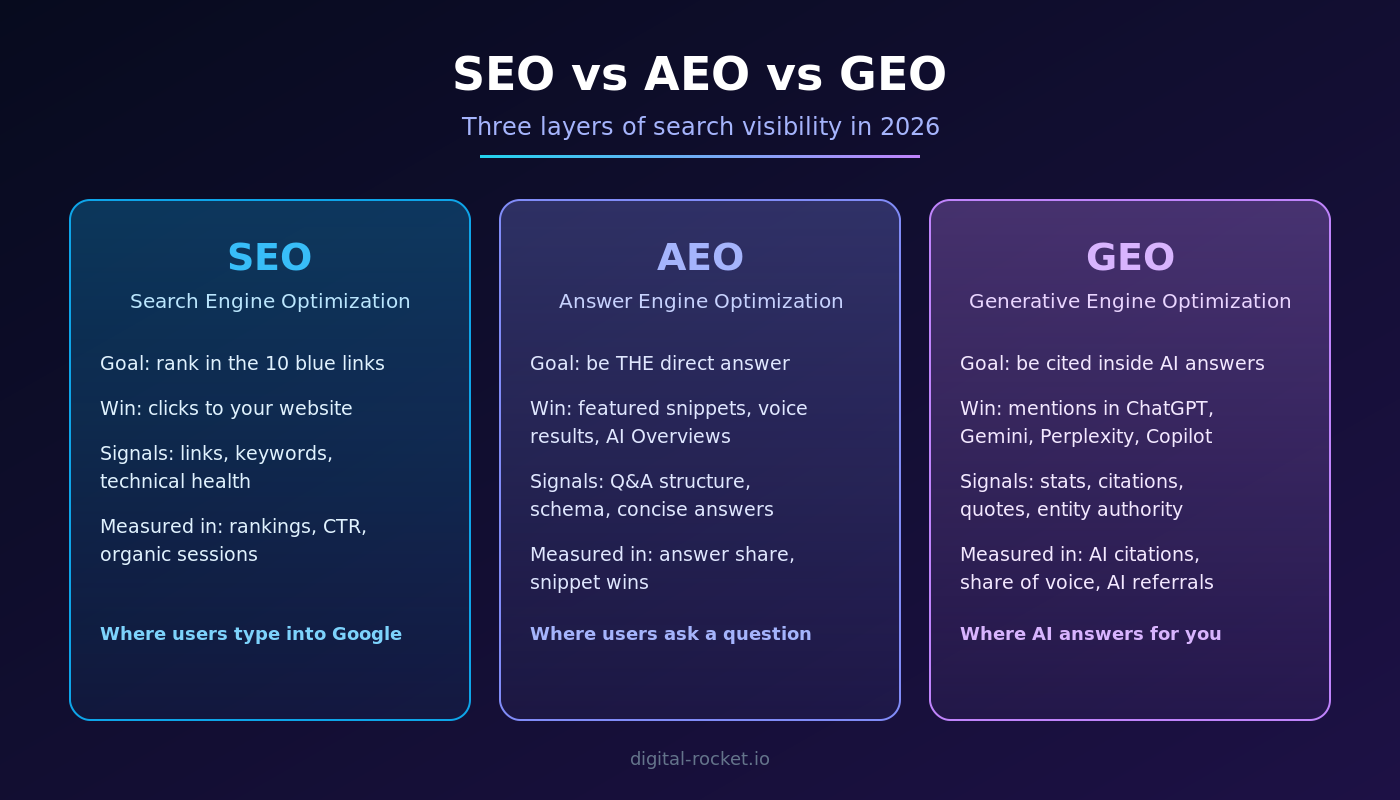
Here is the practical part. These are not competing strategies. A page built for GEO, with direct answers, hard numbers, cited sources and clean schema, also does better in featured snippets and AI Overviews. It stays a strong SEO asset at the same time.
Why GEO matters now: the 2026 numbers
Four data points explain the shift.
- AI referral traffic is growing fast. AI-referred sessions grew 527% year over year in early 2025 (Previsible AI Traffic Report). By late 2025, AI search already drove about 4.5% of organic traffic for B2B SaaS sites, and it kept more than doubling each quarter.
- AI visitors buy like warm leads, not cold traffic. Industry benchmarks put ChatGPT visitor conversion at about 14% to 16% and Perplexity near 10.5%, against roughly 1.8% for regular Google organic. Ahrefs found AI search visitors were only 0.5% of its traffic but 12.1% of its signups.
- Classic organic clicks are shrinking. US organic Google referrals fell about 38% year over year through early 2026, and organic click-through can drop by as much as 61% on queries where an AI Overview shows up.
- Budgets are moving too. The US GEO software and services market is set to reach 365 million dollars in 2026, growing at about 43% a year.
Put simply: the highest-intent channel of 2026 is an answer box you cannot buy your way into. You have to earn the citation.
The GEO playbook: 9 moves that earn AI citations
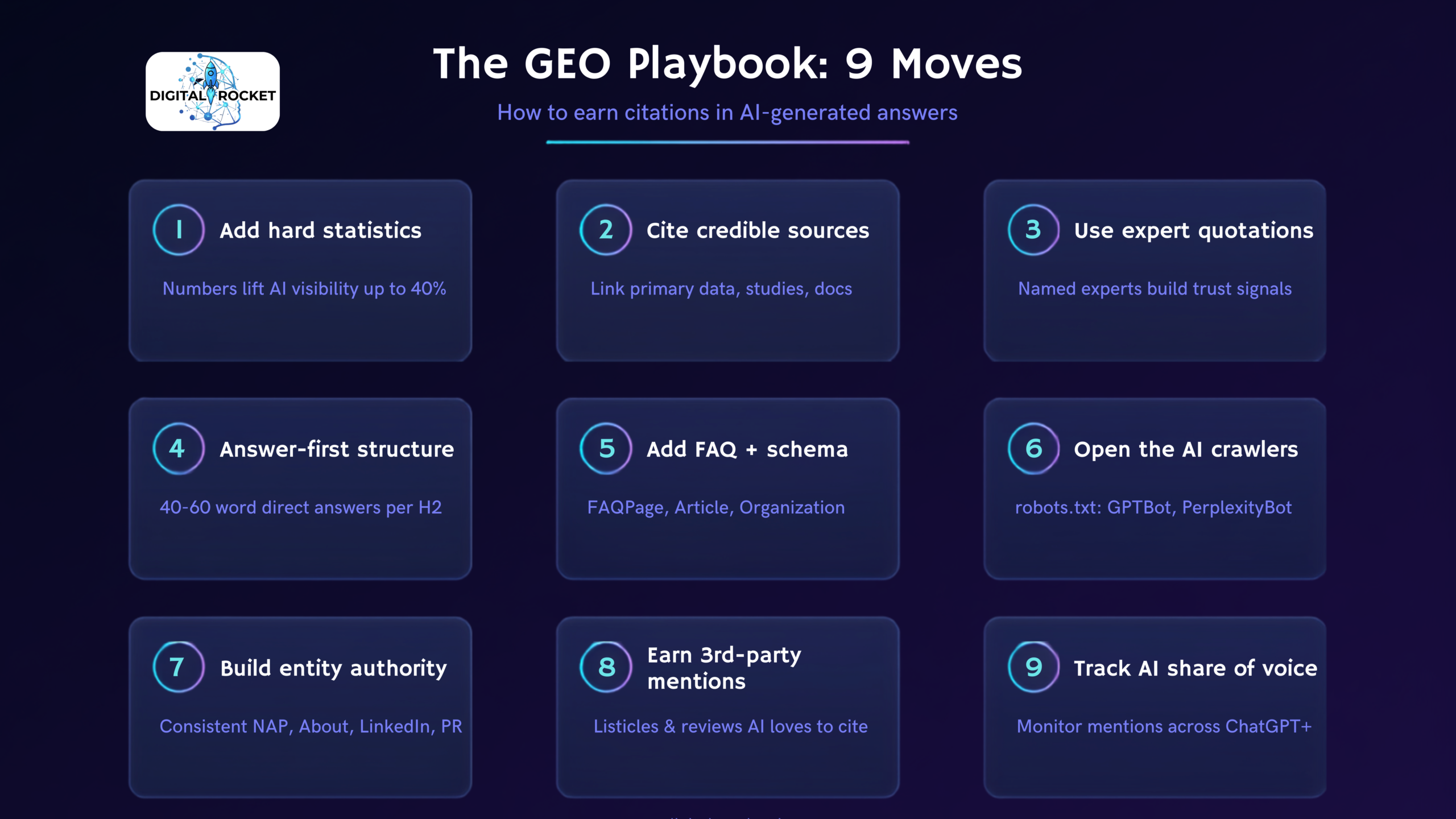
1. Lead with hard statistics
The Princeton GEO study found that adding relevant statistics lifted AI citations by up to 40%, the single strongest tactic they tested. Swap vague claims like “many marketers are adopting AI” for sourced numbers like “AI-referred sessions grew 527% year over year.” AI engines prefer content that gives them real figures to work with.
2. Cite credible sources
Link your claims to primary sources: research papers, official docs, first-party studies. “Cite sources” was a top-three tactic in the GEO study. It also builds the trust signals that help you in classic search.
3. Use expert quotations
Adding quotations was the third high-impact tactic in the Princeton research. Include named, quotable lines from real people, and your own team counts. AI engines treat direct quotes as high-trust evidence they can lift into an answer.
4. Write answer-first (the 40 to 60 word rule)
Open every H2 section with a 40 to 60 word direct answer to the question in the heading, then explain. AI engines pull passages, not whole pages. A short paragraph that fully answers one question is the unit that gets cited. The “What is GEO?” section above is written this way.
5. Add FAQ blocks and structured data
Mark up your articles with Article or BlogPosting, FAQPage and Organization schema. Structured data makes it clear to Google’s AI features and to AI engines who you are and what each question answers. Google’s own AI guidance asks for clear structure and easy-to-lift answers.
6. Open the door to AI crawlers
Check your robots.txt. If you block GPTBot, PerplexityBot, ClaudeBot, Google-Extended or CCBot, you are invisible to the engines you want citations from. Review which crawlers you allow, and make sure key content is not locked behind JavaScript that AI crawlers cannot read.
7. Build brand authority
AI assistants recommend brands, not URLs. Make yours easy to place: a full About page, the same name and description across LinkedIn, directories and review sites, Organization schema with sameAs links, and authors with real bios. If the model cannot work out who you are, it will not recommend you.
8. Earn third-party mentions
Studies of AI citations show that comparison articles and “best of” lists earn the biggest share, over 30% by some counts. AI engines cross-check. They cite you more when other sources, like industry publications, review sites and regional business media, mention you too. Digital PR is now a GEO channel.
9. Track your AI share of voice
You cannot improve what you do not measure. Watch how often ChatGPT, Gemini and Perplexity mention your brand versus competitors for your key questions, like “best growth marketing agency in Dubai,” and track AI referrals in GA4. Purpose-built tools include Ahrefs Brand Radar, Profound and Otterly.
The UAE first-mover advantage
Here is what most global GEO guides miss: AI engines are only as good as the content they can pull from, and for UAE and GCC topics that pool is still shallow.
Ask an AI assistant about performance marketing benchmarks in the US and it can draw on thousands of solid sources. Ask about D2C customer acquisition costs in the Gulf, Ramadan campaign timing, or Arabic and English search behavior, and it has a handful. Publish genuinely strong regional content now and you do not fight for citations. You become the default source. That window closes as regional publishers catch up.
Three practical plays for Gulf brands: publish region-specific data and benchmarks nobody else has; cover Arabic and English topics, since Arabic-language authority is even rarer; and add local brand signals, like a UAE address, regional case studies and MENA awards, so AI assistants recommend you for “in Dubai” questions. This is the thinking behind our own growth marketing and AI-based optimization work.
How to measure GEO (the four metrics that matter)
- AI citation frequency: how often assistants cite your site for your target prompts.
- AI share of voice: your mentions versus competitors across a fixed set of prompts, checked each month.
- AI referral traffic: sessions from chatgpt.com, perplexity.ai, gemini.google.com and copilot.microsoft.com in GA4. Track them on their own, since they convert differently.
- Brand representation accuracy: when AI describes you, is it right? Wrong pricing or old positioning in AI answers is a real loss of revenue.
Frequently asked questions
What is generative engine optimization (GEO)?
GEO is the practice of structuring and promoting your content so AI assistants like ChatGPT, Gemini, Perplexity and Copilot cite your brand in their answers. It focuses on statistics, credible citations, quotations, clear structure and brand authority, not just rankings.
What is the difference between GEO, AEO and SEO?
SEO earns rankings and clicks in traditional search results. AEO earns the direct answer spot in featured snippets, voice search and AI Overviews. GEO earns citations and brand mentions inside AI answers. In 2026, most brands need all three working together.
Does GEO replace SEO?
No. GEO builds on SEO. AI assistants lean heavily on content that already ranks well and on trusted, crawlable sites. Strong technical SEO stays the foundation. GEO adds the formatting, evidence and brand signals that make AI engines cite you.
How long does GEO take to show results?
Content changes like adding statistics, quotations and FAQ schema can affect AI citations within weeks, because assistants read live web results. Brand authority, built from steady third-party mentions, usually takes three to six months.
Why does GEO matter for UAE and GCC brands specifically?
AI answers about UAE and GCC topics draw from a much thinner content pool than US or UK topics, so strong regional content wins citations faster. Early movers in Dubai and the wider Gulf can become the default source AI assistants cite for their category.
How do I measure GEO performance?
Track AI citation frequency, AI share of voice versus competitors, AI referral traffic in your analytics, and brand representation accuracy. Tools like Ahrefs Brand Radar, Profound and Otterly monitor mentions across ChatGPT, Gemini and Perplexity.
Make your brand the answer
GEO rewards what good marketing has always rewarded: real authority, real evidence and clear writing. What is new is the payoff, the AI citation. The brands that build that authority in 2026, especially in under-served markets like the Gulf, will own the answer box for years.
Want to know how visible your brand already is in ChatGPT, Gemini and Perplexity, and how to fix it? Book a free strategy call with Digital Rocket, the AI-native growth marketing agency in Dubai.
Sources: Aggarwal et al., “GEO: Generative Engine Optimization” (KDD 2024) · Google Search Central: AI features guidance · Previsible 2025 AI Traffic Report · Ahrefs AI traffic studies · industry GEO benchmark reports (2025 to 2026).