“What should this cost?” has quietly become the hardest question in MENA marketing. Budgets are set against benchmarks written for the US market, auction prices in the Gulf keep climbing, and — as of 10 July 2026 — Google serves an AI-generated answer on every query by default, repricing the search auction in real time. This guide consolidates the most credible 2026 cost and return benchmarks for the UAE and Saudi Arabia, by platform and by industry, with every number sourced. Use it to sanity-check your media plan, not to replace your own data.
What are typical performance marketing benchmarks in MENA in 2026?
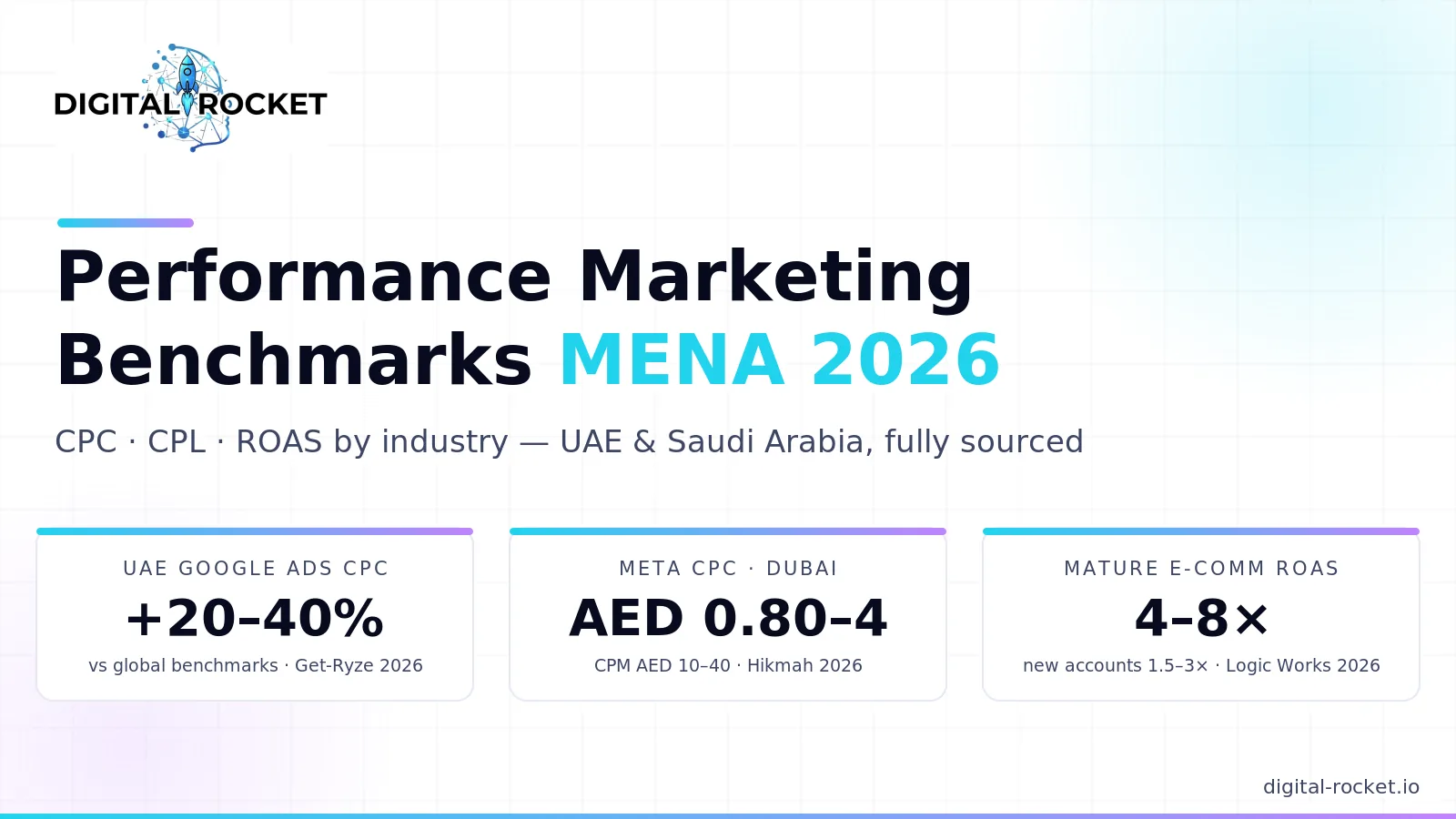
Direct answer: In 2026, UAE advertisers typically pay AED 0.80–4.00 per click on Meta and 20–40% above global averages on Google Ads. Qualified lead costs range from AED 40–90 for dental clinics to AED 400–1,200 for luxury real estate, while healthy ROAS spans 1.5–3× for new e-commerce accounts up to 4–9× for mature Saudi beauty brands.
The money behind those numbers is growing fast. Middle East digital ad spend is forecast to expand by US$8.4 billion to reach US$18.5 billion by 2029 (ResearchAndMarkets, Middle East Digital Ad Spend Business Report, 2026). Saudi Arabia alone will spend US$4.68 billion in 2026 — up 16.8% year on year — and is projected to grow at a 19.4% CAGR to roughly US$7.98 billion by 2029 (ResearchAndMarkets, Saudi Arabia Digital Ad Spend Databook, 2026). Digital already accounted for about 68% of total ad spend in the UAE and Saudi Arabia as far back as 2023 (Statista, 2023). More budget chasing the same auctions means one thing: costs rise, and sloppy media buying gets punished.
How much does Google Ads cost in the UAE in 2026?
Direct answer: The UAE is consistently ranked among the world’s most expensive Google Ads markets, with CPCs averaging 20–40% above global benchmarks due to high purchasing power and fierce competition in finance, real estate, legal and technology (Get-Ryze Google Ads Benchmarks, 2026). Expect qualified real-estate leads at AED 200–800 and a further 10–20% cost rise through 2026.
Global 2026 averages give you the floor, not the ceiling. Benchmarks by industry put average CPC at US$6.75 for legal, US$5.10 for home services, US$2.37 for real estate and US$1.16 for e-commerce (Get-Ryze, Average CPC by Industry, 2026). Applying the UAE’s documented 20–40% premium yields realistic Gulf planning ranges:
| Industry | Global avg CPC (2026) | UAE planning range* |
|---|---|---|
| Legal | $6.75 | $8.10–$9.45 |
| Home services | $5.10 | $6.10–$7.15 |
| Real estate | $2.37 | $2.85–$3.30 |
| E-commerce | $1.16 | $1.40–$1.60 |
*Digital Rocket estimate: global industry CPC (Get-Ryze, 2026) adjusted by the UAE’s 20–40% premium documented in the same benchmark set.
On the lead side, Google Ads real-estate campaigns in the UAE typically deliver qualified property enquiries at AED 200–800 per lead (eShield IT Services, Google Ads Cost in UAE, 2026). And plan for inflation: UAE PPC costs are expected to rise 10–20% across 2026, driven by increased digital adoption and AI-driven bidding (eShield IT Services, 2026). If your account is still running last year’s target CPAs, you are already underbidding.
What are Meta Ads benchmarks in the GCC — CPM, CPC and CPL?
Direct answer: Meta ads in Dubai average AED 10–40 CPM and AED 0.80–4.00 CPC (Hikmah AI Agency, 2026), with the UAE’s average Meta CPM around US$6.50 — a “Tier 2” market globally (Adamigo, 2026). Cost per lead varies enormously by vertical: from AED 40 for dental enquiries to AED 1,200 for qualified luxury-property leads.
The most useful Meta numbers are qualified-lead costs by industry (23HubLab, GCC Meta Ads Benchmarks, 2026):
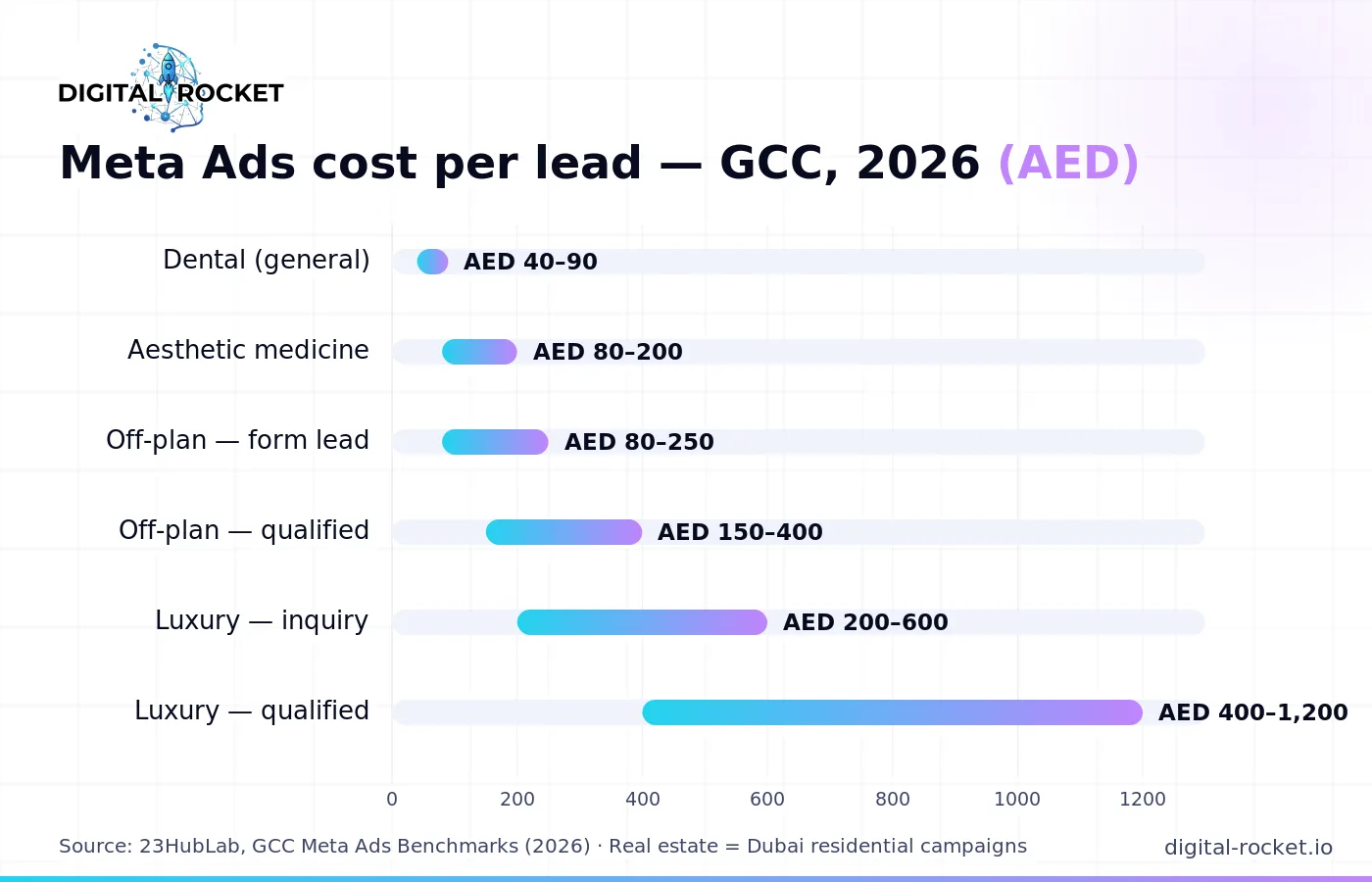
| Vertical | Initial lead (AED) | Qualified lead (AED) |
|---|---|---|
| Off-plan residential (AED 800K–2M) | 80–250 | 150–400 |
| Luxury residential (AED 3M+) | 200–600 | 400–1,200 |
| Cosmetic & aesthetic medicine | 80–200 | — |
| Dental (general) | 40–90 | — |
Two practical implications. First, always benchmark on qualified leads — the gap between a form fill and a sales-accepted lead in Dubai off-plan is roughly 2× the cost. Second, creative is now the main cost lever: top UAE advertisers using Advantage+ with strong creative systems report 4–6× ROAS, while accounts recycling static creative drift toward the bottom of every range. That is precisely the gap our Creative Room and AI-based optimization platform were built to close.
What ROAS should MENA brands expect by industry in 2026?
Direct answer: Mature UAE e-commerce accounts average 4–8× ROAS, while new accounts typically achieve 1.5–3× in the first six months (Logic Works, 2026). Saudi beauty e-commerce reports 4–9×, luxury goods 2–4× (23HubLab, 2026), and B2B businesses with high lifetime value can run profitably at 2–3×.
Seasonality moves these numbers more in MENA than in almost any other region. GCC fashion ROAS peaks during Eid Al-Fitr, when established brands can reach 6–10×, and White Friday campaigns typically deliver e-commerce ROAS 2–4× higher than non-promotional baseline (23HubLab, 2026). A media plan that averages its ROAS target across the year — instead of concentrating budget into Ramadan, Eid and Q4 peaks — systematically overpays for off-peak conversions.
One warning on ROAS itself: channel-reported ROAS is a bidding signal, not a business metric. As attribution weakens across iOS and AI surfaces, blended MER (total revenue ÷ total ad spend) and incrementality tests are the numbers your CFO should see. This is the measurement stack we implement inside our growth marketing engagements.
How does Google’s AI-default search change paid benchmarks?
Direct answer: Since 10 July 2026, every Google query returns an AI-generated answer by default, pushing blue links below the fold (TechTimes, 2026). For advertisers, ads now appear in roughly 29% of commercial AI Mode answers, engagement is ~18% higher, and CPCs carry a ~35% premium — so margin, not volume, decides whether AI placements pay.
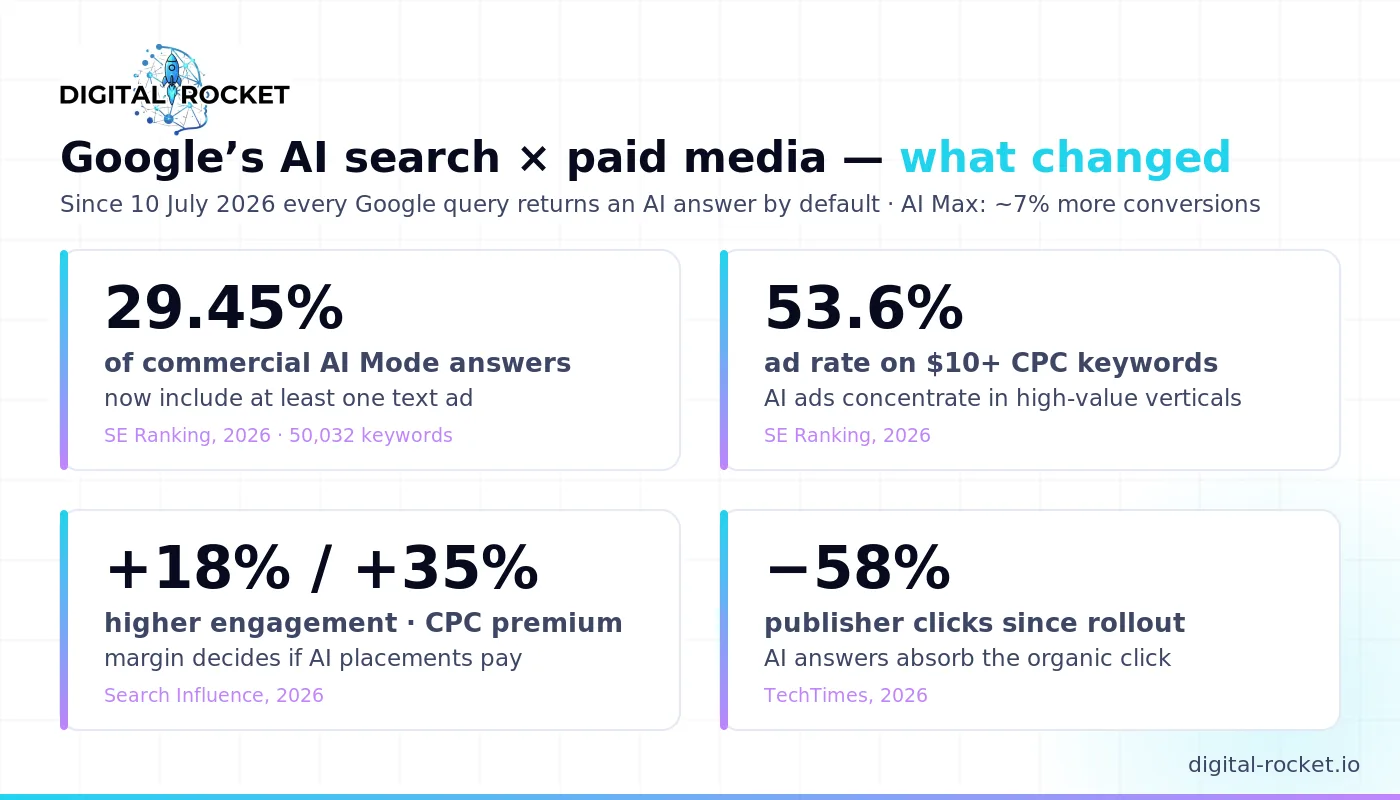
The hard numbers advertisers need:
- A study of 50,032 ad-eligible commercial keywords found 29.45% of AI Mode responses displayed at least one text ad — rising to 53.56% for keywords with CPCs above $10 (SE Ranking, 2026). High-value UAE verticals like finance, legal and real estate are exactly where AI ads concentrate.
- AI Mode ads generate ~18% higher engagement at a ~35% CPC premium (Search Influence, 2026). High-margin services can absorb that premium and still cut effective CPA; low-margin e-commerce often cannot.
- Google reports AI Max for Search campaigns deliver ~7% more conversions at similar CPA/ROAS when the full feature suite is enabled (Google Ads, 2026) — eligibility for AI Mode placements currently flows through AI Max and Performance Max.
- Publisher clicks have fallen 58% since the rollout (TechTimes, 2026). Organic traffic you used to get free now has to be won inside AI answers.
The strategic conclusion for UAE brands: paid and organic can no longer be planned separately. When the AI answer absorbs the click, being cited in that answer (generative engine optimization) and being the ad beside it are the only two ways onto the screen. Our Prism platform analyzes paid performance across these new surfaces in seconds, and our GEO practice handles the citation side.
Where is the cheapest attention in MENA right now?
Direct answer: Snapchat is the strongest arbitrage in the Gulf in 2026: it reaches over 90% of under-35s daily in Saudi Arabia and the UAE, with CPCs reported 50–70% lower than Meta (Hovi Digital Lab, 2026). TikTok momentum is concentrated in fashion, beauty, food services and entertainment.
Underpriced attention rarely stays underpriced, but today the gaps are real. Snapchat’s shoppable AR formats drive measurably higher engagement among Gulf Gen Z, and 60% of Saudi Gen Z use Snapchat to discover new brands (Hovi Digital Lab, 2026). Influencer-led performance also converts: 68% of Saudi consumers say they have purchased a product after seeing it promoted by an influencer (WifiTalents, MENA Media Statistics, 2026). For brands whose Meta CPMs have doubled in two years, shifting 15–25% of prospecting budget into Snapchat and TikTok — with platform-native creative, not resized Meta ads — is the most reliable efficiency play we see in current GCC accounts.
How should you actually use these benchmarks?
Direct answer: Treat published benchmarks as guardrails, not targets. Baseline your own last 90 days, benchmark on qualified leads rather than raw leads, judge channels on blended MER, adjust targets for Ramadan/Eid and Q4 seasonality, and test AI placements against margin thresholds — then re-baseline quarterly.
A simple operating rhythm we run for clients:
- Baseline (week 1): Pull 90 days of your own CPC/CPL/ROAS by campaign and compare against the ranges above. Anything 30%+ worse than benchmark is a diagnosis queue, not a panic button.
- Qualify (weeks 1–2): Rebuild reporting around qualified leads and pipeline, not form fills. In Dubai real estate the difference is 2× on cost — and 10× on sanity.
- Reallocate (weeks 2–4): Shift budget toward the platform/vertical cells where you beat benchmark, and into underpriced channels (Snapchat, TikTok) where your audience skews under 35.
- Test AI surfaces (ongoing): Enable AI Max where margins clear the ~35% CPC premium; measure effective CPA, not clicks.
- Re-baseline quarterly: With Saudi spend growing 16.8% this year and auctions repricing under AI search, any benchmark older than a quarter is a rumor.
Benchmarks tell you what the market pays. They do not tell you what you should pay — that comes from your margins, your LTV and your creative. If you want a second pair of eyes on your 2026 media plan, book a free 30-minute strategy call with our team — we will benchmark your account against MENA data live on the call.
Frequently Asked Questions
What is a good ROAS in the UAE in 2026?
For mature UAE e-commerce accounts, 4–8× is realistic; new accounts typically deliver 1.5–3× in their first six months (Logic Works, 2026). B2B with high lifetime value can be profitable at 2–3×. Saudi beauty e-commerce reports 4–9× and luxury goods 2–4× (23HubLab, 2026).
How much does a real estate lead cost in Dubai in 2026?
On Meta: AED 80–250 for mid-market off-plan form leads (AED 150–400 qualified) and AED 200–600 for luxury inquiries (AED 400–1,200 qualified) (23HubLab, 2026). On Google Ads: AED 200–800 for qualified property enquiries (eShield IT Services, 2026).
Why are UAE CPCs so high compared to other markets?
High purchasing power, a dense concentration of decision-makers, and intense competition in finance, real estate, legal and technology push UAE Google Ads CPCs 20–40% above global benchmarks (Get-Ryze, 2026), with another 10–20% rise expected through 2026 (eShield IT Services, 2026).
Are Google Ads still worth it after the July 2026 AI search rollout?
Yes — but selectively. Ads appear in ~29% of commercial AI Mode answers with ~18% higher engagement at a ~35% CPC premium (SE Ranking, 2026; Search Influence, 2026). High-margin offers usually win; low-margin volume plays need testing. Pair paid with generative engine optimization to stay visible either way.
What is the cheapest ad platform in Saudi Arabia in 2026?
Snapchat: over 90% daily reach among under-35s in KSA and the UAE with CPCs 50–70% below Meta (Hovi Digital Lab, 2026). TikTok is the fastest-growing challenger in fashion, beauty, food and entertainment.
How often should MENA advertisers refresh their benchmarks?
Quarterly. Saudi digital ad spend is growing 16.8% in 2026 (ResearchAndMarkets, 2026), Eid can lift fashion ROAS to 6–10× (23HubLab, 2026), and AI search placements are actively repricing auctions — last year’s numbers are already obsolete.
Digital Rocket is an AI-native growth marketing agency in Dubai. We blend growth marketing, AI-based optimization and generative engine optimization to turn marketing spend into pipeline. Book a strategy call.