
Programmatic Advertising in Dubai: A Practical Guide for Brands
In short
Programmatic advertising is buying ad space through software that decides, one impression at a time, whether your ad should appear on a website, app, video stream or digital screen. It works well in Dubai for brands that want reach beyond Google and Meta, in Arabic and English. Success depends less on the platform and more on three things: where your ads are allowed to run, how quality is checked, and how results are measured.
Most businesses in Dubai start with Google Search and Meta. Programmatic is usually the next step: the same audience thinking, applied across thousands of publishers, apps, video channels and the digital screens you pass on the way to work.
This guide explains how programmatic works in plain language, the deal types and formats worth knowing, what to plan for in the UAE, and the questions to ask before anyone spends your budget.
What programmatic advertising is
Programmatic advertising means buying ad space automatically through software instead of booking it by hand with each publisher. You set the audience, the budget and the rules once. The software then decides, each time a page loads or a video starts, whether that moment is worth buying for you and at what price.
How it differs from Google Ads and Meta ads
Google Search ads respond to what someone types into Google. Meta ads run inside Facebook, Instagram and Messenger. Programmatic reaches across many independent websites, apps, streaming services and digital screens from one buying platform, called a demand-side platform or DSP. Google’s own DSP is Display & Video 360, and there are several others. In short, Search captures demand that already exists, while programmatic is mostly used to build and shape demand across the wider internet.
How a programmatic ad is bought
The whole process happens in a fraction of a second, every time an ad slot becomes available.
You set the rules
Audience, locations, languages, budget, schedule, the sites and apps you allow or block, and the price you are willing to pay, all inside a DSP.
A slot becomes available
Someone opens a news article, an app or a video. The publisher’s supply-side platform (SSP) offers that ad slot to buyers through an ad exchange.
Buyers bid
Each DSP checks the slot against its advertisers’ rules and decides whether to bid and how much.
The winning ad appears
The highest eligible bid wins, and that ad loads on the page, in the app or on the screen.
Results feed back
Impressions, clicks, video views and conversions flow back into the DSP, which uses them to bid better next time.
| Term | What it means |
|---|---|
| DSP | The platform advertisers and agencies use to buy ads across many exchanges and publishers |
| SSP | The platform publishers use to offer their ad space to buyers |
| Ad exchange | The marketplace where DSPs and SSPs meet and auctions take place |
| Deal ID | A code that links a buyer to a specific agreement with a publisher, outside the open auction |
| First-party data | Information you collect yourself, such as website visitors or a customer list, used with consent |
The four ways to buy
Not all programmatic buying is an open auction. The deal type decides how much control you have over where ads run.
| Deal type | How it works | Good for | Trade-off |
|---|---|---|---|
| Open auction | Any eligible buyer can bid on available ad space in real time | Reach and testing at scale | Least control over the exact sites and apps |
| Private marketplace | An invitation-only auction run by a publisher for selected buyers | Better-quality inventory while keeping some competition | Smaller reach than the open auction |
| Preferred deal | A price is agreed in advance, and the buyer gets the first look at the inventory without having to buy it | Priority access to a trusted publisher | Delivery is not guaranteed |
| Programmatic guaranteed | Price and volume are agreed in advance for inventory reserved for one buyer | Launches, sponsorships and premium placements | Least flexible once booked |
Most well-run campaigns mix these: guaranteed or preferred deals with a few trusted publishers, and carefully filtered open auction or private marketplace buying for reach. Google’s help pages for Ad Manager and Display & Video 360 explain how each deal type is set up.
Where programmatic ads appear
| Format | Where it shows | Best used for |
|---|---|---|
| Display and native | Banners and in-feed ads on news, lifestyle and business websites | Reach, retargeting and keeping your brand visible |
| Online video | Ads before or within video on websites and apps | Telling a story that a banner cannot |
| Connected TV | Ads on streaming apps watched on smart TVs | TV-style reach with digital targeting and reporting |
| Mobile in-app | Ads inside mobile apps and games | Reaching people on the device they use most |
| Audio | Ads in streaming music and podcasts | Frequency during commutes and workouts |
| Digital out-of-home (DOOH) | Digital screens in malls, roadsides, airports and buildings, bought by time, place and audience | Local reach in specific areas of the city |
What to plan for in the UAE
Arabic and English creative
Programmatic lets you buy Arabic and English publishers in the same campaign, but each language needs its own creative. Arabic ads should be written in Arabic from the start, not translated from English, and should lead to an Arabic landing page. Dubai’s population is also very international, so some campaigns benefit from creative in other languages your customers use. Our guide to Arabic SEO and Arabic AI search covers how to write Arabic that reads naturally.
Location targeting that matches how the city works
Programmatic can target a whole emirate, a community, or a radius around a mall, a business district or a showroom. Digital screens can be bought for specific places and hours. Match the geography to where your customers actually live, work and shop, and keep separate settings for each emirate so you can see what each one delivers.
Seasons that change the market
Ramadan, Eid, the summer months and Dubai Shopping Festival all shift how people browse and buy, and how many advertisers compete for the same space. Plan creative and budgets around these periods early rather than reacting once they start.
Data and consent
The UAE has a federal personal data protection law, Federal Decree-Law No. 45 of 2021. Before using customer lists or third-party audience data, ask your partner where the data comes from and how consent was collected, and involve your legal adviser for anything you are unsure about.
Brand safety, viewability and fraud
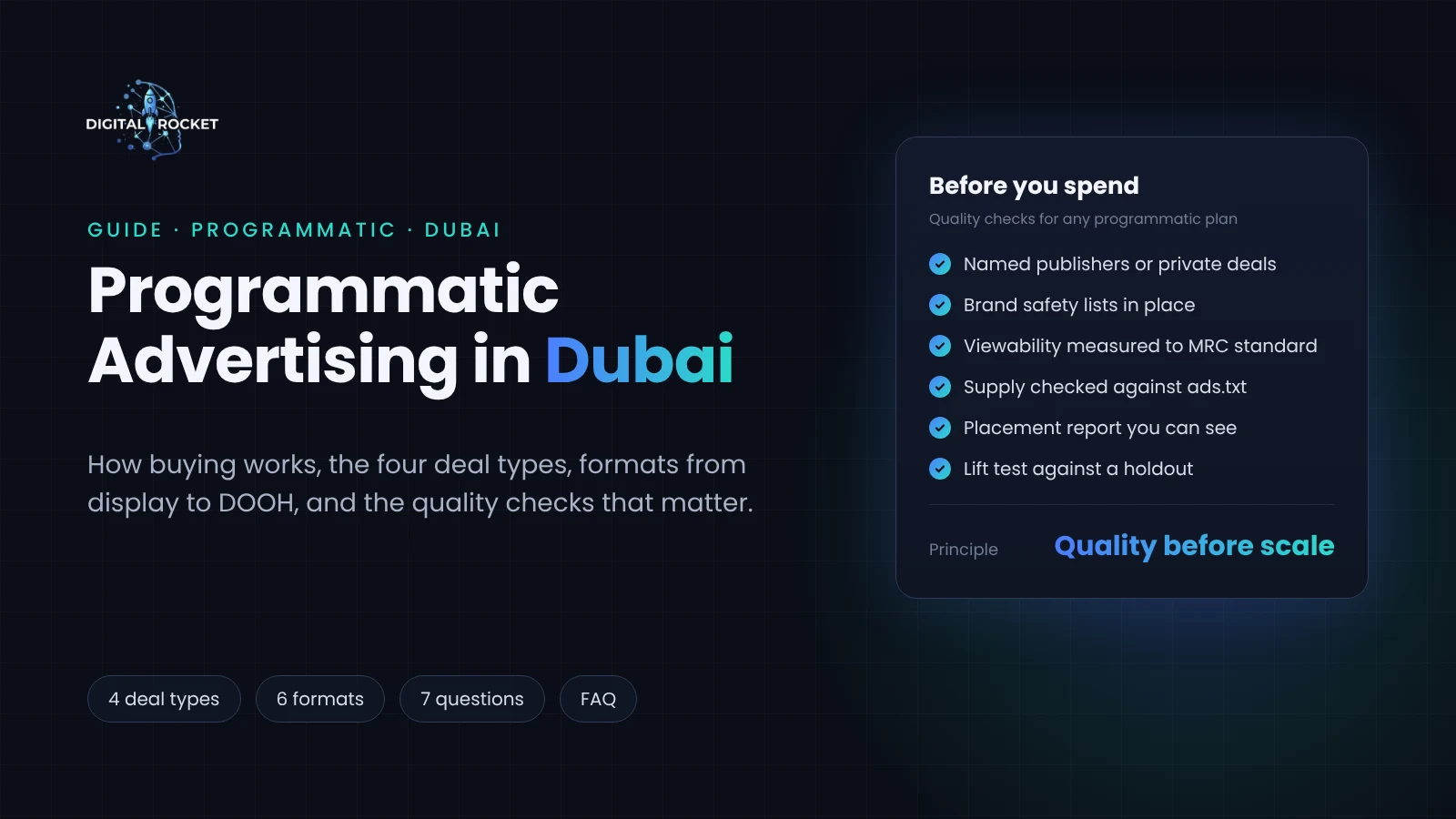
This is where programmatic campaigns are won or lost. A partner should be able to explain each of these clearly.
- Brand safety. Lists of sites, apps and content categories your ads may and may not appear next to, ideally checked by an independent verification tool.
- Viewability. Whether an ad could actually be seen. The industry standard from the Media Rating Council counts a display ad as viewable when at least 50% of it is on screen for one second, and a video ad when 50% is on screen for two seconds.
- Invalid traffic. Fake or automated impressions. Buying only from sellers listed in a publisher’s ads.txt file, a public list of companies the publisher authorises to sell its ad space, cuts out much of the counterfeit supply.
- Transparency. A clear view of which sites and apps your ads ran on, and how much of the budget reached the publisher rather than the platforms in between.
Where cookies stand now
For years the industry expected Google Chrome to remove third-party cookies. That did not happen. In October 2025, Google confirmed that Chrome will keep giving users a choice over third-party cookies, and it retired most of the Privacy Sandbox technologies it had built as replacements. Other browsers, such as Safari and Firefox, already restrict third-party cookies by default.
The practical answer has not changed: rely less on third-party cookies and more on your own consented data, on contextual targeting that places ads next to relevant content, and on publisher audiences offered through deals. Campaigns built this way are steadier, whatever browsers do next.
How to measure results
Measure programmatic against the job you gave it, not against search ads, which reach people who are already looking.
| Goal | What to measure |
|---|---|
| Awareness | Reach, frequency, viewable impressions and video completion rate |
| Consideration | Site visits and engaged sessions from people who saw the ads, and growth in branded searches |
| Leads and sales | Conversions, cost per lead and, ideally, lift measured against a control group that did not see the ads |
Be careful with view-through conversions, which credit an ad that was shown but not clicked. They are useful as a signal but easy to overstate. A simple test with a holdout group gives a far more honest answer. For paid media benchmarks across the region, see our performance marketing benchmarks for MENA.
Is programmatic right for your business?
Programmatic usually makes sense when Google Search and Meta are already working and you want reach beyond them, when you sell to a defined audience that reads specific kinds of content, when you have video or display creative ready, or when local presence in specific areas of the city matters.
It is probably too early if your conversion tracking is not in place, your budget cannot cover a proper test period, or your search campaigns have not yet proved which messages work.
How we approach it. Through our outcome based marketing model, Digital Rocket buys curated programmatic inventory and premium publishers, with the outcome and how it is measured agreed before launch. It sits alongside our wider performance marketing work.
Questions to ask a programmatic partner
Which DSP will you use, and why that one?
The answer should relate to your audience, formats and the publishers you need, not only to what the agency always uses.
Which deal types and publishers will you start with?
Ask for named publishers or private deals, not just “premium inventory”.
How do you protect brand safety and filter invalid traffic?
Look for verification tools, ads.txt checks and site lists you can review.
How is viewability measured and reported?
Ask which standard is used and what happens to placements that fall short.
Can I see where every ad ran and where the budget went?
You should get placement reports and a clear split between media cost and fees.
Who owns the data and the reporting?
Audiences built from your customers and site visitors should stay yours.
How will you prove the campaign added something?
A holdout or lift test is the strongest answer.
For a wider checklist that applies to any agency, see how to choose a digital marketing agency in Dubai.
What shapes the cost
Programmatic is usually priced per thousand impressions, and the cost depends on the format, the audience, the deal type, the publishers and the season. Video, connected TV and premium private deals generally cost more than open auction display. On top of media sits the cost of data, verification tools and campaign management. For a plan and quote based on your goals, message us on WhatsApp or book a strategy call.
Frequently asked questions
It is buying ad space automatically through software. Instead of booking ads with each website by hand, you set your audience, budget and rules, and the software decides in real time which ad slots to buy for you.
No. The Google Display Network is Google’s own network of sites and apps, bought inside Google Ads. Programmatic through a DSP can reach many exchanges and publishers at once, including private deals that are not available in Google Ads.
Yes, but it works best once search and social campaigns are already bringing results and tracking is in place. Start with one goal, one audience and a focused list of publishers, then expand what works.
Digital out-of-home bought programmatically: ads on digital screens in malls, on roads, in airports and in buildings, bought by location, time of day and audience rather than as a fixed booking.
Less than before. Chrome still lets users choose whether to allow them, while Safari and Firefox restrict them by default. Strong campaigns now lean on consented first-party data, contextual targeting and publisher audiences.
It depends on the formats, audiences, publishers and deal types you choose, plus data, verification and management. For a plan and quote based on your goals, message us on WhatsApp or book a strategy call.

Written by the Digital Rocket team. Digital Rocket is an AI-native growth marketing agency in Dubai, working with brands across the UAE and the GCC on performance marketing and SEO and GEO.
Talk to us
If you want to reach new audiences beyond Google and Meta, we can share how we would plan a programmatic campaign around your goals. Book a 30-minute strategy call or send us a message on WhatsApp. You can also email talphonse@digital-rocket.io.